Conference in Chisinau on continuing the pace for further EU enlargement
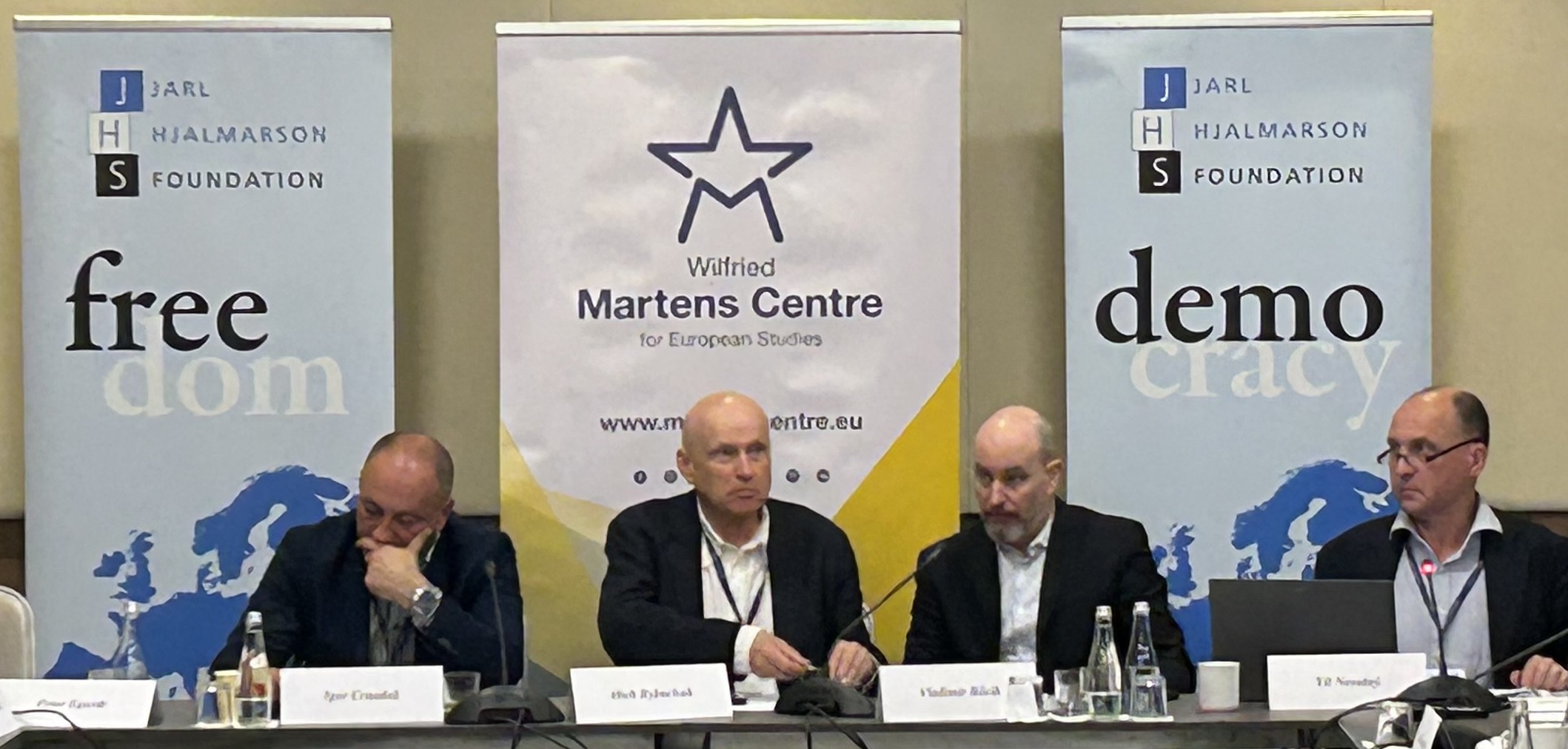
The Jarl Hjalmarson Foundation in cooperation with the Wilfried Martens Centre for European Studies hosted a conference in Chisinau in late May on continuing the pace for further EU enlargement. A distinguished group of participants discussed the strive for democracy, promoting rule of law and anti-corruption through institutional reforms and the needs and demands for further enlargement.
Oleh Rybachuk, Chairman, Centre UA and Former Ukrainian Deputy Prime Minister for European Integration, gave the following introduction.
Europe Completing Itself: Why Enlargement Matters Now
The recent meeting in Chisinau made one thing unmistakably clear: this is no longer just a point on the map. It has become one of the places where Europe is being tested in real time.
Here, as in Ukraine and across the Western Balkans, Europe is no longer an abstract idea or a technical negotiation process. It is lived reality. It is about survival, dignity, and the right to exist without being told by an external power who you are.
If Europe wants to understand what enlargement means today, it should look beyond policy papers and institutional debates. It should look here, at countries where the European choice is no longer theoretical, but operational.
For a generation in Ukraine, Europe was once a dream. For the next generation, it has become a job description, a daily responsibility, a path that is being built step by step.
And that shift changes everything. Enlargement is no longer an act of goodwill or a romantic project. It has become part of Europe’s security architecture.
Europe Is Not Expanding, It Is Completing Itself
For many years, enlargement was described as a linear process in which candidate countries knocked on the door while Europe assessed whether they were ready to enter.
That narrative is no longer sufficient. The distinction between “inside” and “outside” is becoming increasingly artificial.
The synchronization of Ukraine’s and Moldova’s electricity grids with the continental European system in March 2022 was a defining moment. Technically, it was about infrastructure. Politically, it was a clear statement: the connection already exists.
The key question today is not when these countries will become European. They already are.
The real question is whether European institutions are ready to catch up with this reality.
Enlargement as Strategic Self-Interest
Europe has never enlarged out of sentiment. It has done so when it recognized that its own future was at stake.
The European Union today is one of the largest democratic economic areas in the world. Yet scale alone does not guarantee strength.
Recent global developments have demonstrated this clearly. Territory without freedom can become a tool of aggression. Economic weight without democratic principles can become pressure. Even alliances can shift with political cycles.
Europe’s strength, therefore, must come from something different. It lies in the size of its democratic space, the reliability of its rules, and the trust citizens place in institutions over individuals.
The EU single market is not just an economic structure. It is Europe’s peaceful superpower.
Expanding that space to include societies that have already paid a high price for belonging to it is not a burden. It is a form of renewal.
The Experience Europe Now Needs
There is a recurring argument that enlargement should wait until candidate countries are less complex.
But Europe’s history tells the opposite story. Enlargement has never happened in easy moments.
Spain and Portugal joined after authoritarian rule. Central Europe joined after communism. The Baltic states joined with fresh memories of occupation.
Each time, it seemed risky beforehand. Each time, it was later described as strategic vision.
Today, Ukraine, Moldova, and the Western Balkans bring more than challenges. They bring experience that Europe now urgently needs.
They understand external pressure before it reaches formal political analysis. They recognize disinformation before it becomes an electoral threat. They treat energy independence as a security priority, not just an environmental goal.
They know that corruption is not a cultural issue but a structural vulnerability.
And they understand that civil society is not decoration. It is the immune system of democracy.
Institutions do not become strong because political actors suddenly improve. They become strong when citizens refuse to leave politics only to politicians.
A Reality Moving Faster Than Politics
Candidate countries are not standing still. They are moving forward, often in extremely difficult conditions.
Under military pressure, cyberattacks, disinformation, economic constraints, and domestic fatigue, they continue to reform.
This challenges a comfortable assumption that they are waiting for Europe.
They are not waiting. They are transforming.
The question now increasingly shifts to the European Union itself: can it reform with the same seriousness and determination it expects from others?
No Shortcuts, but No Endless Waiting
There can be no compromise on rule of law, independent institutions, anti-corruption measures, public governance, and fundamental rights.
These are essential pillars of a strong Union.
At the same time, the principle of “no shortcuts” must not turn into a system with no clear outcome.
When a country delivers on reforms, Europe must respond. Otherwise, conditionality loses credibility.
Europe must be strict on reforms and allergic to excuses.
The Cost of Delay
One of the most dangerous assumptions is that postponement is neutral.
In reality, a grey zone never remains empty. If Europe does not fill it with rules and institutions, others will fill it with influence, money, coercion, and fear.
Delay is a policy choice. And often, it is the most expensive one.
Ukraine understands this. Moldova understands this. The Western Balkans understand this.
Strategic ambiguity may sound sophisticated in conference rooms. On the ground, it often means giving space for instability.
What Europe Must Do
A stronger Europe requires three essential elements.
First, political courage. Enlargement must be framed clearly as a strategic choice for Europe itself, not a favour to others.
Second, institutional adaptation. A Union of more than thirty members cannot function with the dynamics of a smaller club. Governance structures must evolve accordingly.
Third, societal ownership. Enlargement cannot remain a conversation among diplomats alone. Citizens across Europe must understand why developments in Kyiv, Chisinau, or Sarajevo directly affect their own lives.
This requires translating geopolitics into everyday relevance: security, jobs, prices, justice, and dignity.
Europe in a Global Context
The European Union is unique. It does not only connect markets. It transforms states.
It is more than a trade area. It is a system that turns complex historical experiences into predictable rules and stable institutions.
That is why enlargement matters globally. It demonstrates that democracy is not shrinking. It is still capable of expanding.
Conclusion
The essential question today is simple.
Not whether Europe can afford enlargement, but whether it can afford the alternative.
Can it afford grey zones?
Can it afford unstable borders?
Can it afford to leave democracies alone until they are exhausted?
Can it afford to ignore the choice of societies that chose Europe under pressure, under threat, and under attack?
The answer is clear.
A stronger Europe will not be built out of fear of new members. It will be built out of confidence in its own model.
And if Europe still believes that democracy, rule of law, and human dignity are stronger than empire, corruption, and fear, then enlargement is not a problem to be managed.
It is proof that Europe still believes in itself.